I reviewed The Farnsworth Invention at New Theatre for Australian Stage. You can read it here.
Sunday, July 24, 2011

Thursday, July 14, 2011
Friday, July 1, 2011
World Wrestling Entertainment
 WWE RAW was in Sydney at the Acer Arena on 1 July 2011. It will play at Rod Laver Arena in Melbourne on 2 July, the Burswood Dome in Perth on 3 July, the Adelaide Entertainment Centre in Adelaide on 4 July and the Brisbane Entertainment Centre in Brisbane on 5 July. Presented by Dainty Group.
Not all theatre is highbrow, and not all theatre aspires to it. Some theatre is pretty much ashamed to admit that it is theatre, or indeed staged in any way. Oh no. It is all real, and it is sport, damn it. And from this, you get the glory that is World Wrestling Entertainment - the WWE.
My sister and I attended this NIGHT OF GLORY together. This is not our normal scene. We were very far out of our comfort zones. Both of us had several existential crises, complemented by out of body experiences... which then had out of body experiences of their own. We shared/suffered through/loved this experience together so we're writing this review together, conversation style. So... here you are.
JOJO: Hi, Hazzabangerz.
BANG: Hello, Jodi. It's been such a lovely night at the theatre!
JOJO: That's an interesting point you raise there, Bang Bang. WWE calls itself 'sport' and people steadfastly refuse to admit it is scripted, when it obviously is. I refuse to believe real life dialogue would ever be that a) awful, and b) hilarious. So do you think that WWE really is 'theatre' per se?
BANG: Of course it's theatre. The entire event is about the audience's suspension of disbelief, knowledge of catchphrases, signature 'moves', and the storyline is dense. Each wrestler is a caricature of a real athlete and - I may be making a sweeping genalisation here - behaves more melodramatically and narcissistically than Ridge Forrester (on crack).
JOJO: I think the Ridge analogy is a good one, because at the end of the day, let's face it, WWE is a giant soap opera about men wearing no pants and women dressed as 80s superheroes pretending to punch each other. Personally, I could use less punching and more of the hilarious talking. I could have listened to CM Punk's opening rant 'calling out' (another WW
 E favourite thing to do) corporate America and the WWE execs a lot longer. But no, Rey Mysterio HAD to go and punch him in the face.
BANG: Oh, CM Punk! My favourite wrestler of all! Technically, he's a villain - but he cares in a meaningful way about grammar!
JOJO: The heroes/villains thing is really weird, actually. It is obvious to both you and I that CM Punk is the coolest of all the wrestlers, and yet he is cast as a villain with an evil cult that rallies around him. He's also militantly straight edge (which he has tattooed to his stomach) ...but yeah, that isn't terribly relevant to my point - which is that in normal sport, you have your team or your individual or whoever that you pull for, with little real outside involvement. For example, I like Roger Federer and barrack for him because I think he's awesome. But in WWE, because of the theatricalised, scripted elements of it, the writers (well, 'writers') can lead you to like or dislike certain characters by casting them as heroes or villains and then give you a guaranteed happy ending (ie. the good guy beats the bad guy while you shout a lot). It's very safe to barrack for a hero in WWE.
BANG: Imma stop you there, Jojo! It's safe to be on the winning team... until R-Truth steps onto the scene! Tonight's MAIN EVENT featured reigning WWE champion John Cena (hero) and the recently-insane challen
 ger R-Truth (villain). Truth has 'SHUT UP!' written on the back of his jeans, breaks through audience barriers, threatens small children ('Little Jimmies'), and tells Sydneysiders they smell like 'doo-doo'. He also stole someone's drink. Very poor form indeed.
JOJO: And yet until recently, R-Truth was portrayed as a hero-figure in the WWE universe. Character/actor/wrestler/whatever-you-want-to-call-thems can cycle through both the hero and villain spectrums, but you always know who you should be going for. It's like reading a romance novel or a crime novel. You know there will be some kind of payoff at the end where good defeats evil. Though for us this is obviously troubling in the case of technically evil CM Punk, who is - problematically for the entire WWE - obviously a freaking legend.
BANG: I prefer the villains, in the end. I don't care about the emotional pay-off. I want to see plots, schemes, hitting people with steel chairs!
JOJO: Agreed. The actual wrestling aspect of wrestling is not particularly interesting. In fact, it looks even faker in real life (if that is possible). It's stunningly obvious when someone has landed on the floor next to someone's head rather than on their head, that kind of thing. And the acting level was often not high... someone would get kicked in the head and then clutch their knee, that kind of thing.
BANG: The part that really gets me is when the scripted narcissism gets in the way of winning a fight. When The Miz manages to get his ex-apprentice-now-nemesis Alex Riley on the ground, he's so easily distracted by the crowd calling him a wanker. 'I am NOT a wanker!' yelleth The Miz, upon which occasion Alex Riley punches him in the head. Miz also falls victim to the wrestling trend of dancing around in anticipation of a signature move. It is neither big nor clever to pretend you are a magpie looking for worms, or whatever it is he's intending.
JOJO: On that subject, why were those Nexus dudes so terrified when Santino Morella was chasing them round and round the ring doing a Lleyton Hewitt style emu hand? Is that really such a powerful move? EMU PECK! OWWWWWWWWWWWWWWWW THE PAINZ.
BANG: Yeah, I wonder why Santino lost that match. There were also some top-quality wardrobe decisions in this part of the show - I particularly enjoyed David Otunga's bedazzled speedos.
JOJO: They were indeed dazzling. There's something very spesh about all WWE fashion and its peculiar brand of pantlessness. I regularly find myself barracking for the ones that wear pants PURELY BECAUSE they are wearing pants and not some bizarre speedo/gogo boot combination (or worse, a unitard). CM Punk is obviously an exception to this rule, but those black and pink speedos are not going to win him best-dressed dude in the WWE.
BANG: I'm a little sad Dolph Ziggler has ditched his old outfit, the inside-out-and-backwards pleather hotpants. Now he's advertising himself as Mr. Perfection, an interesting move
 considering he's 99% chin. 99% chin, 1% pants. 100% peasant.
JOJO: I'm a bit sad that his WWE girlfriend (not to be confused with any real girlfriend he might have) Vickie Guerrero didn't make the trip to Australia. One of my favourite parts of WWE is the fake relationships and all the shenanigans that go on there. Fake relationships, fake engagements, fake weddings, fake adultery... I'm pretty sure there was a fake pregnancy one time... It really is a soap opera. Let's face it - WWE would be totally boring if it were really about wrestling. It's more theatre than sport - much more about the characters than the punching.
BANG: Let's not forget the audience involvement! No fourth wall here! What would WWE be without a whole stadium of people shouting 'YOU CAN'T SEE ME!' whilst waving their hands in front of their faces like windscreen wipers? In fact, one of the highlights of tonight's show was the audience volunteer dance-off, orchestrated by diva Kelly Kelly.
JOJO: Yes! That was SUPREMELY excellent. I love watching total strangers completely humiliate themselves in front of an entire stadium of people just for the chance to meet a WWE superstar. (The winner chose to meet John Cena, if anyone cares. I don't. I'd venture Bang doesn't either.) And people were scrambling and screaming to be in this dance-off! It was like one of those maniacal religious riots you read about in ancient myths - vaguely Dionysian. And Dionysus was, as we know, the god of theatre.
BANG: Dionysus would have loved this party! He would have taken a shine to contestant number three, who had the good taste to wear some Nexus (CM Punk's cult) merchandise but the bad taste to wear his pants around his ankles. Wardrobe malfunction almost became human sacrifice. He also introduced himself to Kelly Kelly as 'Dave Baby'.
JOJO: What a charming young fellow he was. I am SO SURPRISED he didn't win. Even in the genuinely unscripted part of the WWE show, the whole hero/villain thing orchestrated by the writers behind the scenes paid off. As soon as he got up there in that Nexus shirt, he was doomed. Of course, his self-pantsing probably didn't help.
BANG: Why don't any wrestlers 'pants' each other? It seems like a sensible tactic. I also wanted to see some hair-pulling (particularly from the divas who had all that weave flying around), but the closest we came was Dolph Ziggler chinning Kofi Kingston in the ponytail. Thanks Dolph Ziggler, Lord of the Chin-stand.
JOJO: That chin-stand was pretty spesh. Another moment of which I was particularly fond, because of the excellent writing demonstrated - seriously, SUCH SKILL - is when villainous The Miz took the microphone and told the crowd, 'shut up, I want to say my catchphrase'. I WONDER WHAT THE WRITERS THOUGHT WOULD HAPPEN NEXT. Certainly not five minutes of The Miz putting the microphone to his mouth only to be interrupted by the crowd going GISDHFLSHFKUHWKFHKIUSHFDKJH at him. (His catchphrase is 'Because I'm The Miz... and I'm awesome!' if anyone is interested. I could not see anything particularly awesome about him... even his speedos and gogo boots were dull by WWE standards.)
BANG: It was really obvious who was written as a villain because they all initiated their monologues with a generalised insult towards Australia. Even CM Punk. I cried.
JOJO: It's okay, Bang Bang. It's theatre. He didn't mean it. We know he's a freaking legend.
Thursday, June 30, 2011
The Coming World
 The Coming World runs until 3 July 2011 at Darlinghurst Theatre. By Christoper Shinn, directed by Caroline Craig.
The Coming World was, to me, a play almost completely incongruous with its title. The term 'coming world' is epic, bringing to mind far horizons, a sweeping scale, Lord of the Rings style cinematography and possibly a few apocalypses. However, what it was was a story about a girl who worked in a video store and her relationships with a set of rather dysfunctional twins. It may have been set on a beach, but the scale was hardly sweeping (in any case, on the Darlo stage, 'sweeping' would be rather difficult'). The Coming World was not exactly universal - instead, it was almost aggressively insular.
This insularity is not necessarily a bad thing, but - as noted above - it did put the play at odds with its title. Dora (Cheree Cassidy), who works in Blockbuster, is dating Eddie (Ian Meadows), who is stupid enough to get conned into being a drug mule. What Eddie does next ends up defining the entire story - his actions break like the waves of the beach on which the play is set (you see what I did there) over both Dora and his twin Ty, with whom Dora spends the second half of the play. Despite the ripple effects of Eddie's actions, however, there is a real sense of containment and claustrophobia about this play. Dora and Ty are both bound to and trapped by Eddie, even after Eddie removes himself from the picture. Apparently, The Independent said of this play:
"The Coming World is a small play, but, after it ends, you can still feel the ripples."
I feel this is a pretty fair assessment, but considering this small play had so much stuff packed into it, I feel like it should have been saddled with a less epic title.
Both Cassidy and Meadows were very effective in their roles - especially when I got used to the New England accent they affected. (Embarrassing note - I skimmed the blurb, missed the New and read the England, and thus spent the first five minutes thinking 'this is the worst English accent I have ever heard EVER!') Meadows seemed more comfortable as Ty than Eddie, and Cassidy seemed to relate better to him as this character rather than as Eddie. I felt that in both acting and directing, the second half of the play was superior to the first. The play was really about Dora and yet most of the time she was not the agent behind any actions. In the second half, interacting with Ty instead of Eddie, she at least got to move things forward a little instead of providing resistance for the increasingly erratic Eddie.
Caroline Craig's direction was intelligent - the salient plot points and themes were certainly hit - but I felt at times the play was a little sedentary and could have used an injection of movement. However, the writing, rather than the direction, is probably at fault for this - there is no point in a lot of the scenes where movement seems sensible. The little Darlo stage definitely suited the insularity of the piece and Charlotte Lane's design, coupled with the lighting design of Jack Audas-Preston, was outstanding. The scene where Dora was floating in the sea with the light shining through the seaweed/video tape was incredible. I loved it.
This play was definitely a small play - it didn't really have a lot in way of plot - but it crammed a lot of themes in there, and not all of them were necessary. In places, I felt it succumbed to a flaw common to literary fiction, which is themes for the sake of themes. Maybe I just didn't get it, but there was a massive emphasis on clothing and costume and tattooes and suchlike which just did not seem related to the plot or to characterisation in any salient way. To go all Year 9 English on it, if there had been more of an appearance vs reality bent to the play, maybe it would have been more appropriate. Despite only being an hour long, I felt like the script sometimes got bogged down in itself, obsessed with its own intensity and complexity.
Overall, The Coming World was a well-acted, well-directed, spectacularly designed night at the theatre - but at the end, I felt there were a few too many loose ends that needed tidying up. This was largely a) because of the plays proliferation of and preoccupation with OMGDEEPTHEMES; and b) the rather abrupt and out-of-the-blue ending, which to me (and to my psychology-studying sister, who was with me), did not seem in any way anticipated by the rest of the play. The production of it was very hard to fault, but I'm having trouble working out what The Coming World was trying to say. I do not expect theatre to spoon feed me answers - but in many cases, I would have liked to have understood where the questions were coming from.
Wednesday, June 8, 2011
Heartbreak Hotel
 Heartbreak Hotel was a one-night-only event on 8 June 2011 at the SBW Stables Theatre, Kings Cross, as part of Griffin Theatre Company's Festival of New Writing.
There are a special breed of people in the world for whom Kate Bush is the goddess of everything, keeper of all wisdom. I am one of these people, and like it that way. I am firmly of the belief that there is a Kate Bush song for everything, and in true Kate-is-the-greatest style, I was vividly reminded of one walking back to Kings Cross station after my evening at Heartbreak Hotel. The song is Love and Anger. Here's a sample of some of the lyrics:
"Take away the love and the anger
"And the little piece of hope holding us together
"Looking for a moment that'll never happen
"Living in the gap between past and future."
Not one of Kate's OMGgreatesthits, nor one of her more obscure - she's hardly suspended in gaffa here - but I think it sums up neatly what Heartbreak Hotel was about. It was about love, anger, and
 the end of hope - and what happens after. What do you do when something is over? How do you reassemble yourself and learn to love again? Does hope really spring eternal? And how do you stop being so damn angry about it?
I was a little nervous going into Heartbreak Hotel. A little of this was because my date bailed on me and so I was there alone like a total nigel (apt, considering!) but mostly because I wasn't quite sure to expect, and I was worried it might tend towards the performance art. I am terrified of performance art. It is a bizarre phobia. I am in no way opposed to the concept, but unlike 'true' theatre, where I can go all reception theory and apply my own reading to a performance, I am always afraid with performance art that I won't get it and thus completely undermine myself as a professional smart person.
No, I did not say it was a sane phobia. I am well aware it is completely mad.
Anyway. I am still not sure where to classify Heartbreak Hotel - is it theatre? is it performance art? is the difference between these two completely arbitrary and pointless in my mind anyway? - but I am sure of the fact that I enjoyed the evening and didn't come away feeling like I didn't get it or anything like that. I know I missed things. Originally, I believe this project was called the Museum of Broken Relationships and I think I like this name better than 'Heartbreak Hotel', because this is what it was: a theatricalised museum, full of exhibits and interaction - the kind of place you want to return to, because you know you didn't get to everything. I would have loved to see Glace Chase, the agony aunt, and experience the Teen Love Crush, but there just wasn't time. And sadly for me, I cannot go back - the hotel was one night only.
It was completely packed, and Griffin might have benefited from opening the hotel/museum for a few nights to mitigate the demand - I feel this keenly as a short person who is continually getting stuck behind tall people and never being able to see. However, given the many other awesome things going on during the Festival of New Writing, I can see why they didn't. And maybe that would somehow lessen the impact of the experience anyway - spreading it out might weaken the blow, so to speak.
My favourite part of the heartbreak smorgasbord was the sensory sound lock, where hotel guests were taken one by one into the cleaner's closet, blindfolded and beset with smells and tastes and other sensory stimuli. Theatre is a necessarily visual medium and so taking away that key sense and forcing people to engage with a story on another, almost visceral level was both exhilarating and confronting (particularly if the story you were engaging with was as vengeful and angry as mine!) A massive part of the appeal of theatre is the immediacy, the tangibility, the closeness, but even then, looking at something and seeing the difference and the distance between you and it is a barrier created by sight. The sound lock removed that and it was theatrical storytelling in the most immediate sense. I loved it.
I wasn't so keen on Shut Up, the performance in the front alcove, for which hotel guests all wore headphones while actors did a sort of stylised movement thing. Maybe it triggered my fear of performance art - who knows? but it was probably largely because I was standing behind people a good foot taller than me. It is hard to be short. I had a case of this in the other headphoned piece, also held in the foyer, but then the actors conveniently marched right out onto the road and I (awesomely) had front row viewing. This piece was very raw and very real - it had a sense of theatre of the invisible about it, even though the actors were very clearly ignoring the bazillions of people obviously staring at them (not just a fourth wall here!)
Yes, No, Maybe out in the park was a gorgeous little piece (albeit cold - why, why, why did Sydney have to have one of its coldest nights in living memory on hotel night!) and I also really enjoyed Sands Through the Hourglass upstairs in the theatre, which evoked memories of the first ever play I saw at Griffin - Quack, the zombie play. The woman in this piece was so perfectly doll-like it was eerie, and the man was adorably well-meaning in the most sinister way - a houngan who had stolen the soul of his zombie bride. It was heartbreaking and chilling all at the same time. And also, I got free bubbles.
Heartbreak Hotel was like theatrical therapy - cathartic and ultimately hopeful, despite it being about the end of love, the end of hope, and the overpowering desire for revenge. I loved the idea of it as a museum - as preserving things that are past, are dead, are history, so that we can learn from them and move forward.
And yeah, I also enjoyed writing a brief, angry letter to my ex and posting it in the box there. Love and rage are sides of the same coin.
Sunday, May 22, 2011
Much Ado About Nothing
 Much Ado About Nothing runs until 25 June. It plays at the Canberra Theatre Centre until 4 June and at the Melbourne Arts Centre until 25 June 2011. By William Shakespeare, directed by John Bell.
I sometimes think I have a bit of a split personality, particularly when I watch theatre. Perhaps it is the curse of the academic - I go through life seeing things on one hand as normal Jodi, and on the other hand as Jodi the Scholar, for whom everything is potential thesis material. Watching Much Ado About Nothing made me hyper-aware of this dual nature of my personality. Luckily, both Jodis really enjoyed it.
Jodi the Scholar is a PhD student who's writing a thesis on virginity and who has a particularly love of Renaissance literature, and so Much Ado is ripe with material. Although the play is obviously about Benedick (played wonderfully in this production by Toby Schmitz) and Beatrice (the excellent Blazey Best), they're not the drivers of the plot. In fact, if all you saw was the first half before interval (to the end of Act III, Scene II, ending deliciously on the word 'sequel'), you'd assume there wasn't much of a plot. Basically, there's this dude called Benedick and this chick called Beatrice, and they make out that they don't like each other but they obviously are head over heels for each other and totes have a history, and so their friends put together a plan to hook them up.
But then in the second half it all gets a bit dark.
Benedick's mate Claudio and Beatrice's cousin Hero are engaged – Claudio saw her, thought she was a bit of all right, and she (and, moreover, her father) was down with it - and it all seems hunky dory. But then Claudio, through a convoluted series of events involving what is played in this production as the mafia, gets it into his head that Hero isn't a virgin, and the plot really kicks off. And instead of taking her aside and going, 'hey, Hero, so I heard this crazy rumour, how about we have a discussion here,' Claudio decides to humiliate her at the altar. Because a woman who's deflowered is a woman who's worthless.
I have written a lot about the commodification of virginity in Renaissance literature - I'm presenting a paper on it in Canada next week - and we have a perfect example of it here. Jodi the Scholar, watching this, was all, I should put more Much Ado in my conference paper. Claudio finds a deflowered Hero not only worthless, but loathsome. And Hero's father Leonato isn't far behind - he screams at his daughter not to open her eyes when he thinks that she's been deflowered. The only one who immediately comes to Hero's defence is Beatrice, who manages to convince Benedick that she's right.
This obviously sits uneasily with the modern audience - both the nature of Claudio and Hero's engagement and the fetishisation of Hero's virginity. John Bell has dealt with this unease in a
 subtle way, I think... there is something very petty and a bit poisonous about the bromance between Don Pedro and Claudio, and when Leonato tells them that they have essentially killed his daughter, they are sorry, but yet somehow nonchalant about the whole thing. Don Pedro, Claudio and Benedick are a group of three friends who like to joke around together, bros, a sort of Shakespearean Ted/Marshall/Barney How I Met Your Mother trio, and the Bell production really emphasises this, but the Hero incident really does reveal their true colours - Benedick cares enough to stay behind and see that Hero is all right, and then (after coercion from Beatrice) cares enough to challenge Claudio to a duel. And then at the second wedding, when Claudio is to marry the veiled girl (who really is Hero, but which he doesn't know yet), Bell has kept in an often cut line - Claudio says he will marry her even if she is an Ethiop. There was an awkward silence all around the theatre when he said this as everyone realised he really is an enormous douchelord.
However, Much Ado really is a romcom. The plot may focus on Claudio and Hero, whose eventual union leaves the modern audience with an immense sense of unease, but we all know that Benedick and Beatrice, the real focus, will be much happier... even though they'll fight like cats and dogs. There's a concept I remember reading about in my life as Jodi the Scholar called the erotics of talk which I think plays into the difference between the two relationships - Hero/Claudio is based on Claudio thinking Hero is hot. Beatrice and Benedick is based on wit and dialogue - an erotic connection through conversation. And all audiences - Renaissance and modern - are led to believe this is the superior one.
Right. Jodi the Scholar is going to stop wanking on and on about random academic concepts and start talking about the actual show now. Normal Jodi is in the house. And she loved it.
 The show stealer was clearly Toby Schmitz's hair - that fifties coiffe he affects at one stage is HILARIOUS - but Schmitz himself was outstanding. At first, his very Australian accent was a little jarring, but after a few lines it seemed perfectly natural. This was an example of excellent, EXCELLENT casting - Schmitz wore this role like a glove. He embraced the awkwardness and the embarrassment and the reluctance to admit change that is at the core of Benedick, and it was awesome. He's not afraid of silence on stage, and some of his funniest moments were silent - or at the least non-verbal, where he made incoherent noises of protest. And the scene where he's under the pool table listening to Don Pedro, Claudio and Leonato talk... priceless.
I really cannot speak highly enough of Schmitz's performance in this role. The only criticism I have is that he did overshadow a lot of the other characters - even Beatrice. Blazey Best was an excellent Beatrice, but with material which is not quite as awesome as Benedick's and such a great performance opposite her, I think it was a little hard for her to live up to. All this said, she really was good. She and Schmitz were a bit adorable together. Okay, a lot.
Bell held off on having Benedick and Beatrice kiss right until the very end and I think that was a great directorial choice. The awkwardness between them when they've admitted that they love each other but they're not quite together yet was just perfect. A lot of versions have Benedick and Beatrice being a little too couple-y too early, and this one didn't fall into that trap. The moment at the end when they read the (saucy) sonnets that each has written about the other was just fantastic theatre.
Jodi the Scholar and normal Jodi both loved this production. I highly, highly recommend it. And seriously - check Toby Schmitz's hair. There's a double meaning in it. Somewhere.
Tuesday, April 19, 2011
Orange Flower Water
 Orange Flower Water has now closed. It played at Darlinghurst Theatre from 23 March – 17 April 2011. By Craig Wright, directed by Byron Kaye.
I really, really wanted to like Orange Flower Water at Darlo. I cannot TELL you how much I wanted to like it. I'd read such good things in the reviews and I love Six Feet Under and I have a major soft spot for that little little Darlo stage and I was super excited about going to see it, even though I only managed to squeeze in the Saturday before they closed. Someone compared it to Speaking In Tongues, for heavens' sakes, and we all know how I felt about THAT play.
Lloyd Bradford Syke wrote in his review that:
"You won't just see this play. You'll feel it, deep in the pit of your stomach. If you don't, or can't, relate, you haven't lived."
Well, then, I guess I haven't lived, because as much as I wanted to like this play, it just did nothing for me.
I think you were supposed to identify with the characters, feel their pain. I couldn't. They were all too frustrating. Cathy seemed nice enough, and Amy Mathews turned in a heartfelt performance here. However, her character's run got cut a bit short – you never really saw her after her big scene, which was (as everyone who saw the play knows) the long, drawn out, explicit sex scene with her cheating husband David (Joseph Del Re). There was also nothing wrong with Del Re's performance, except I didn't understand why David fell in love with Beth (Megan Alston), which is obviously at the crux of the character. Whether this fault lies with Del Re or with the writing or the directing... I'm not sure. Perhaps a mixture of all three.
It was easy to understand why Beth fell out of love with her husband Brad (Sebastian Goldspink) as he was completely vile and thoroughly unlikeable. When a character says "I ought to rape you, you f^&*ing c*nt", I think it makes them pretty much irredeemable. Sure, his wife had just announced that she was leaving him and his emotions were running high, so to speak, but yeah... completely unforgiveable. If I was supposed to feel his pain, that ensured I never would, on account of I was too busy loathing him.
So I understood why Beth left Brad for David. All over that. What I didn't understand was why she was crying ALL THE DAMN TIME. 
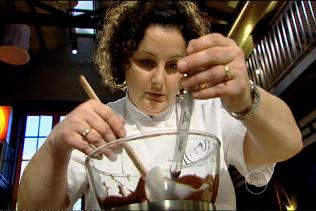
I have very limited patience with crying on stage. The more you cry, the less effective it becomes. It doesn't signal that you're all emotional and fragile and whatnot, because the audience – well, me, anyway – becomes totally inured to it. It's like when you watch Masterchef and they're all standing there having a cry and you don't go 'awwwwww', you go 'LESS CRYING MORE COOKING' because they've been crying for what seems like five episodes now and you just want to see them make a cake without it melting in the rain Macarthur Park style. If Beth had broken down once, maybe twice, then maybe I could have been Team Beth. But no. The way Alston played her, she was CRYING ALL THE TIME. And I didn't sympathise – I wanted to smack her.
Relationships and adultery are territory that has been traversed by many writers many, many times. If you're going to do it and make it stand out, it has to be pretty damn good. The majority of people seemed to think Orange Flower Water was that standout. But it just didn't work for me. There were elements I liked – I thought the set design was inspired, for instance. Setting the whole thing in a bedroom was really clever – a play about an intimate subject deserves an intimate setting, and the smallness of the Darlo theatre lent itself well to the claustrophobic atmosphere, as did the continued presence of all four actors on stage. I thought the performances were mostly very good – Mathews in particular, with an honourable mention for Del Re. Goldspink couldn't really help what an enormous douche Brad was, I suppose, and for the brief minutes when Alston's Beth wasn't in tears she was good.
But the play just didn't live up to the billing. For me to really feel the pain of these characters – to feel it like Lloyd Bradford Syke did – I think I needed to like them a little bit, not spend the play pretty much w anting to punch them. And the ending... no. I'm writing a PhD thesis on romance novels, and it just totally smacked of that bit you get at the end of so many category novels where suddenly the hero and heroine have a baby, signalling their happily ever after. I didn't really feel like anything was resolved by the time David delivered his final 'BTW, we have a baby now and we are OMG SO HAPPY' monologue. In a way, this play touched on the least interesting aspect of adultery, and ended just where it should have begun. Breaking up is, in essence, the easiest part. It's what happens after that was interesting. The play was just beginning to touch on that with David and Beth looking at houses near the end. If the play had begun there, I think it would have been much more interesting.
 anting to punch them. And the ending... no. I'm writing a PhD thesis on romance novels, and it just totally smacked of that bit you get at the end of so many category novels where suddenly the hero and heroine have a baby, signalling their happily ever after. I didn't really feel like anything was resolved by the time David delivered his final 'BTW, we have a baby now and we are OMG SO HAPPY' monologue. In a way, this play touched on the least interesting aspect of adultery, and ended just where it should have begun. Breaking up is, in essence, the easiest part. It's what happens after that was interesting. The play was just beginning to touch on that with David and Beth looking at houses near the end. If the play had begun there, I think it would have been much more interesting.
Maybe it's because the last play I saw about adultery was Speaking In Tongues, which remains one of the greatest shows I have ever seen performed. But Orange Flower Water just did not live up to the hype for me. And to be honest, I feel pretty bad about it, because I love Darlo and I was really, really looking forward to this show. But I didn't feel it. It didn't get me deep in the pit of my stomach. It left me wondering what the hell I'd missed.
Subscribe to:
Posts (Atom)